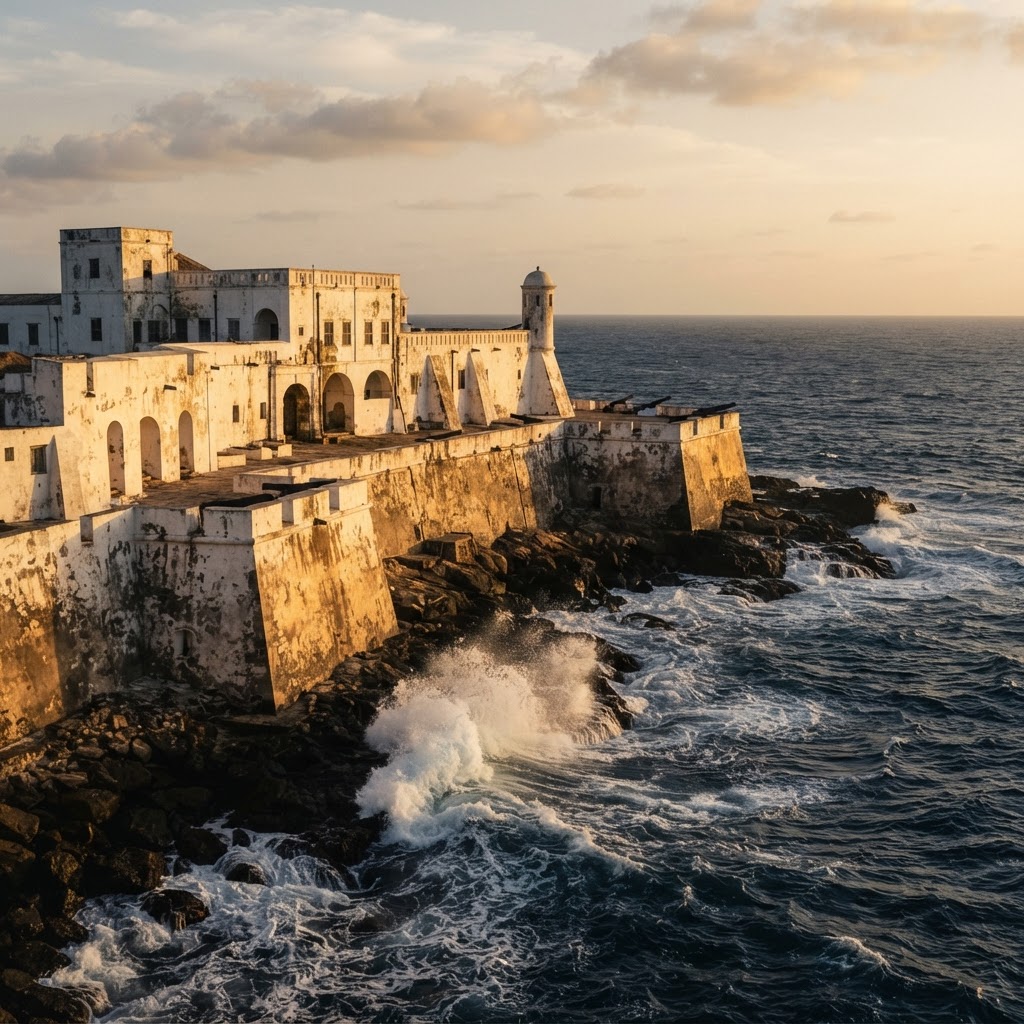
Walking the Door of No Return: A Ghana Heritage Guide
Everything you need to know before visiting Cape Coast and Elmina castles — from what to expect emotionally to how to prepare your family for the experience.
There are trips you take to relax, and there are trips that change how you understand yourself. A visit to Ghana's slave castles is firmly the second kind.
I've been sending clients to the Caribbean, Mexico, and Europe for years, and lately I've been intentionally building more travel around the African diaspora — the places our history actually runs through. Ghana sits at the center of that story. For a lot of my clients, standing at the Door of No Return is the reason they book the whole trip. Everything else — the beaches, the food, the market days — becomes the part that lets you breathe again afterward.
So let me walk you through what this experience actually is, how to prepare yourself and the people you love for it, and the practical details that make the difference between a rushed stop and a day you'll carry with you.
What the Door of No Return actually is
Cape Coast Castle and Elmina Castle sit on Ghana's central coast, about fifteen minutes apart. From the water they look almost beautiful — whitewashed walls, cannons, the Atlantic stretching out behind them. That contrast is the whole point, and it's the first thing that hits you.
Inside, the story is different. These were holding sites in the trans-Atlantic slave trade. Enslaved Africans were kept in dark, airless dungeons for weeks or months before being walked through a single narrow doorway onto boats bound for slave ships waiting offshore. That doorway is the Door of No Return. For most who passed through it, there was no coming back.
Elmina is the older of the two — St. George's Castle, built by the Portuguese, the oldest European structure of its kind still standing in sub-Saharan Africa. Cape Coast Castle is the larger site and holds the fuller museum. Both are UNESCO World Heritage Sites. Both keep their Door of No Return, and at Cape Coast there's a second sign on the ocean side of that same door: the Door of Return, added to honor the descendants who come home.
What to expect emotionally
I want to be honest with you here, because I'd rather over-prepare you than have you caught off guard.
The guided tours take you down into the dungeons. You'll stand where hundreds of people were held in the dark. You'll see the condemned cell — the room where people were left to die. You'll see the church that was built directly above the dungeons, which tells you everything about how the people running these castles saw the people below them. And then you'll walk to the Door itself.
Reactions vary. Some people go quiet. Some cry. Some feel anger, some feel a strange steadiness, some feel nothing in the moment and then everything a day later. All of it is normal. There is no correct way to feel, and there's no performance required. Your guide will give you space.
A few things I tell every client:
- Let yourself go in without an agenda. This isn't a photo stop. Some rooms you won't want to photograph at all, and that instinct is right.
- Build in quiet afterward. Don't schedule a packed evening for the same day. Give yourself dinner, the ocean, and room to process.
- Talk about it together. If you're traveling as a couple, family, or group, the conversation on the ride back is often the most meaningful part of the whole vacation.
Preparing your family — especially children
This is the question I get most from clients traveling multi-generationally, and it's a good one. The honest answer is that it depends on the child.
For younger children, the dungeons and the subject matter can be genuinely upsetting, and some of the physical spaces are dark and tight. I generally suggest that children under about ten either sit out the dungeon portion with one adult while the rest of the family tours, or that you visit Cape Coast's museum galleries and grounds without going all the way down. You know your child best.
For older children and teens, this can be one of the most formative things they ever do — but it lands better with preparation. A few ways to set them up:
- Talk about it before you go, in age-appropriate terms. Don't let the castle be the first time they hear this history.
- Read or watch something together beforehand. Even one good book or documentary gives them a framework so they're not processing it cold.
- Tell them it's okay to have feelings and okay to step outside. Naming that in advance takes the pressure off.
- Leave room to debrief. Teens often go silent in the moment and open up hours later. Let the conversation come when it comes.
For elders in your group, be mindful of the stairs and uneven stone underfoot — some of the passageways are steep and low. It's very doable, just not fast.
The practical details
Here's what you actually need to know to plan the day.
Getting there. Both castles are on the coast, roughly a three-hour drive west of Accra depending on traffic. Most of my clients base the day around a private driver-guide rather than a group bus — it lets you set your own pace, take the quiet you need, and pair the castles with nearby stops.
Hours and tickets. Cape Coast Castle is generally open daily, around 9:00 AM to 5:00 PM. Guided tours are included with admission and run about 60–90 minutes; Elmina's tours run closer to 45–60 minutes. Fees are modest and differ for Ghanaian and international visitors. Important: bring cash in Ghana cedis. Card machines are unreliable at both sites, and many vendors and guides take cash or mobile money only.
Do both, or choose one? If you have the day, I recommend seeing both — they tell the story differently, and doing them back to back is powerful. If you only have time for one, Cape Coast has the more complete museum and is the more common choice for a first visit.
Pair it wisely. Kakum National Park, with its canopy walkway high in the rainforest, is close by and makes a natural second-day contrast — something that lifts the spirit after a heavy morning. I usually structure it as castles one day, Kakum and the coast the next, so the two experiences don't compete.
Tip your guide. These guides carry heavy material every single day, often with personal connection to it. A gratuity is expected and deeply earned.
When to go
Ghana is warm and tropical year-round, so the real planning question is rain.
- Best window: the main dry season, roughly late November through March, brings the most reliable sunshine and easiest travel on the coast. December is especially alive — this is when many diaspora travelers come home, and the energy across Accra and the coast is remarkable.
- Shoulder season: July and August fall in a shorter drier spell between the rains and can be a good value with lighter crowds.
- Heaviest rain: May through mid-July, and again around September–October. Not off-limits, but expect downpours and some humidity.
What to pack for the castle day:
- Lightweight, breathable clothing in modest cuts — you'll be walking and it's hot
- Comfortable closed-toe shoes with grip for uneven stone and stairs
- A refillable water bottle and sun protection (hat, sunscreen, sunglasses)
- Cash in cedis for entry, guides, and vendors
- A light layer or scarf — the dungeons are cool and damp
- Tissues, and a little emotional room in your schedule
Where to stay
I always give my clients two directions to choose from, depending on the vacation you're building.
Elevated / five-star feel: Base yourself in Elmina or Cape Coast at a beachfront property with full service, ocean views, and pool — somewhere you can return to and truly decompress after the castles. This is the right call if you want your heritage days framed by real rest and comfort.
Comfortable mid-range: A well-run boutique property or guesthouse near the coast, clean and characterful, closer to the town rhythm. Ideal if you'd rather put more of your budget toward experiences and a private guide than toward the room.
Either way, I'd steer you toward staying at least one night on the coast rather than doing the whole thing as a long day trip from Accra. The drive is real, and rushing this particular experience is the one thing I'd ask you not to do.
Experiences worth adding
The castles anchor the trip, but the fuller picture of this region is what stays with people. A few things I love building in:
- A private local guide for the castles who can speak to the history with depth, not just the script
- A traditional coastal meal — fresh grilled fish, red red, jollof — ideally hosted or home-cooked rather than in a hotel dining room
- The Kakum canopy walk for a completely different kind of day
- Time in Elmina's fishing harbor in the morning, when the painted boats come in — one of the most alive scenes on the coast
- For December travelers, the Year of Return–era events and festivals that fill Accra and the coast that month
This is exactly the kind of vacation I've been building more of lately — travel that connects you to something, not just somewhere. If Ghana has been on your heart, or you've felt the pull to make that journey to the Door of No Return, let's talk about what your version of this trip looks like. Reach out and we'll start mapping it together — the right season, the right pace, and the space to actually feel it.
Ready to plan? Send me a note and let's put your Ghana heritage vacation on the calendar.
Enjoyed this story? Join our newsletter for more travel inspiration.

